|
Romuald Hazoumé
"La Bouche du Roi"
The British Museum, London
March 22-May 23, 2007
The first question one might ask about Romuald Hazoumé's "La Bouche du Roi" piece is why it is in the British Museum. It is after all, a contemporary multimedia work, seemingly better suited for a more contemporary space. It may very well be an act of penance on the part of an institution that, both in terms of name and the character of its collections, (the Rosetta stone stands prominently in one of the galleries) reverberates with the clarions of empire. This is a month during which there are various ceremonial events enacted by the government that at least ritualistically and rhetorically address the agonized consequences of the slave trade. However, experiencing the work, you get the sense that much more is at stake than face saving or even unflinching self appraisal.
The work uses found objects critical to the survival of many people within Hazoumé's community inside Benin. The tops of plastic petrol canisters are severed from the rest of their bodies and it is in these "bodies" stretched over fire to their outward capacity (the process is demonstrated in a video projected within the room), that petrol is carried from one village to the next by drivers who risk their lives to make a life. In the museum, the truncated heads lay angled on each other row upon row face up, each mouth an "o" gape that one may imagine as the "Oh" of shock or disruption, but perhaps also recognition and dawning clarity. The heads--along with small conclaves of gin bottles, bowls of beads, cowrie shells and other items that were used for trade--form a cross-sectioned image of a slave ship on the gallery floor.
This is a work about bodies that refers to them through several urbane devices we in the west can easily identify: the trope of synecdoche, the strategy of accumulation to overwhelm, the multi-sensual levels on which the installation speaks. But, concurrent with these, is an invoking of the physical through the muffled sounds of native voices and the raw stink that strikes you intermittently (and perhaps dampens the easy sentimental response). Ultimately, this show is not primarily for us. According to the artist, the work seeks to address his own people to imbue a sense of self awareness by prosecuting a historical awareness through revealing their shared reality as one in which the present ghosts the past, repeatedly, redundantly and tragically. What dos it take to hold and keep a body together, in different historical times, in varied cultural contexts, in distinct economic realities? We should begin to know by now, because when the bodies unravel all our rituals fail to restore them.--Seph Rodney
Mario Ybarra Jr.
"Bring Me the Head of..."
Anna Helwing Gallery, Los Angeles
January 20 - February 24, 2007
| Mario Ybarra Jr. |
|
| where my dogs at |
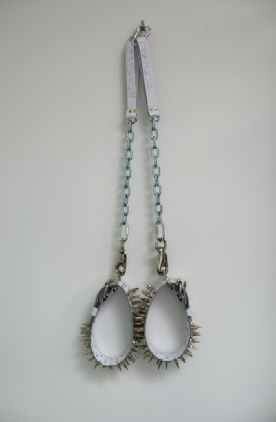
Ybarra negotiates an ambivalent sense of personal power and identity in a show riddled with characteristic humor, political overtones and bellicose reflection: twin spiked dog leashes bear his name and his gallerist's; both fame and death are foreseen in an "MVP" trophy featuring his dismembered LA Dodgers capped head; a narco-trade diagram substitutes mix tapes for drugs which generate money, guns, but also a community's welfare. Ybarra seems trapped, hostage to his own art practice as much as his cholos (etymology, 17th century: "dogs") to their monster-slaying counterparts. We hope he makes it out soon, alive. --Carrie Paterson
Marilyn Minter
Baldwin Gallery
Aspen, CO
December 26 - January 31, 2007
Minter's painterly C-prints seduce in the way an auto-accident makes heads turn. The large glossy images of couture are ridden with mud (this seasons's Prada heel, a favorite); gender-unspecific eyelashes caked in mascara, moisture and expectation become canvases against our swimming, liquid, desiring stares. Lips drooling pearls. Braces tearing at chewy candy. Glamour has never been so inviting to its curious, spell-bound spectator. In the project room, 9 black and white prints document the artist's bedridden, substance abusing mother over twenty years, a marvelous sensual creature seen only in a housecoat, through a mirror, or as a shadow of her own glorious imagination.--Carrie Paterson
Group Exhibition: "Consider This..."
LACMA Lab
Los Angeles
April 9, 2006 - January 15, 2007
Some of the places, history, ideas and artifacts present in this participatory, all-ages show include The Belmont Tunnel, where graffiti writers share space with an ancient Olmec ball game (Ybarra Jr.); the rhythmic chaos of a Cairo marketplace paired with a parade through an African-American neighborhood (Bradford); the desert landscape of Zabriskie Point as a place to consider violence, women, race and coming of age (Cypis); "burning" in protest and reactionary acts (Yonemoto); the mythological landscape of Jewish male identity (Rantzer); and the plight of animals stored in the Natural History Museum, refugees from a shrinking environment (Honda). -- Carrie Paterson
Edgar Arceneaux
"The Alchemy of Comedy ... Stupid"
Susanne Vielmetter Projects
Los Angeles
October 28 -December 2, 2006
Arceneaux breaks down logic and linearity in this tribute to the transformational legacy of black comedy. He presents paintings of bottled "humors" (significantly, "black bile"), drawings laden with pathos (Richard Pryor's wheelchair, Pryor near death, Pryor's own mock-crucifiction/lynching), and the acts of comedian David Alan Grier. 9 video channels traversing the space simultaneously play Grier's stand-up routines and spill over the audience. They "entertain" us - in the sense of making some "accommodation" as our shadows unavoidably interrupt the image plane. Though often unintelligible, we are disarmed and embarrassed by a "good joke".--Carrie Paterson
Kori Newkirk
Corey McCorkle
MC Kunst, Los Angeles
October 21 -- November 22, 2006
A critical investigation of urban topology, McCorkle and Newkirk use a similar minimalist language to mark specific moments of circularity and obstruction. Newkirk's clear plexiglass fire escape never makes it to the floor, only doubling back on itself as a futile closed system. Reminiscent of Robert Gober's "Crib", in this site identities are born from structures that thwart their development. Newkirk's "bling" stairway seems to wish for, suggest, erase and transcend race and class in its diamond brilliance. McCorkle stacks New York City paving bricks into a massive low wall that divides space but still allows communication. --Carrie Paterson
|
